
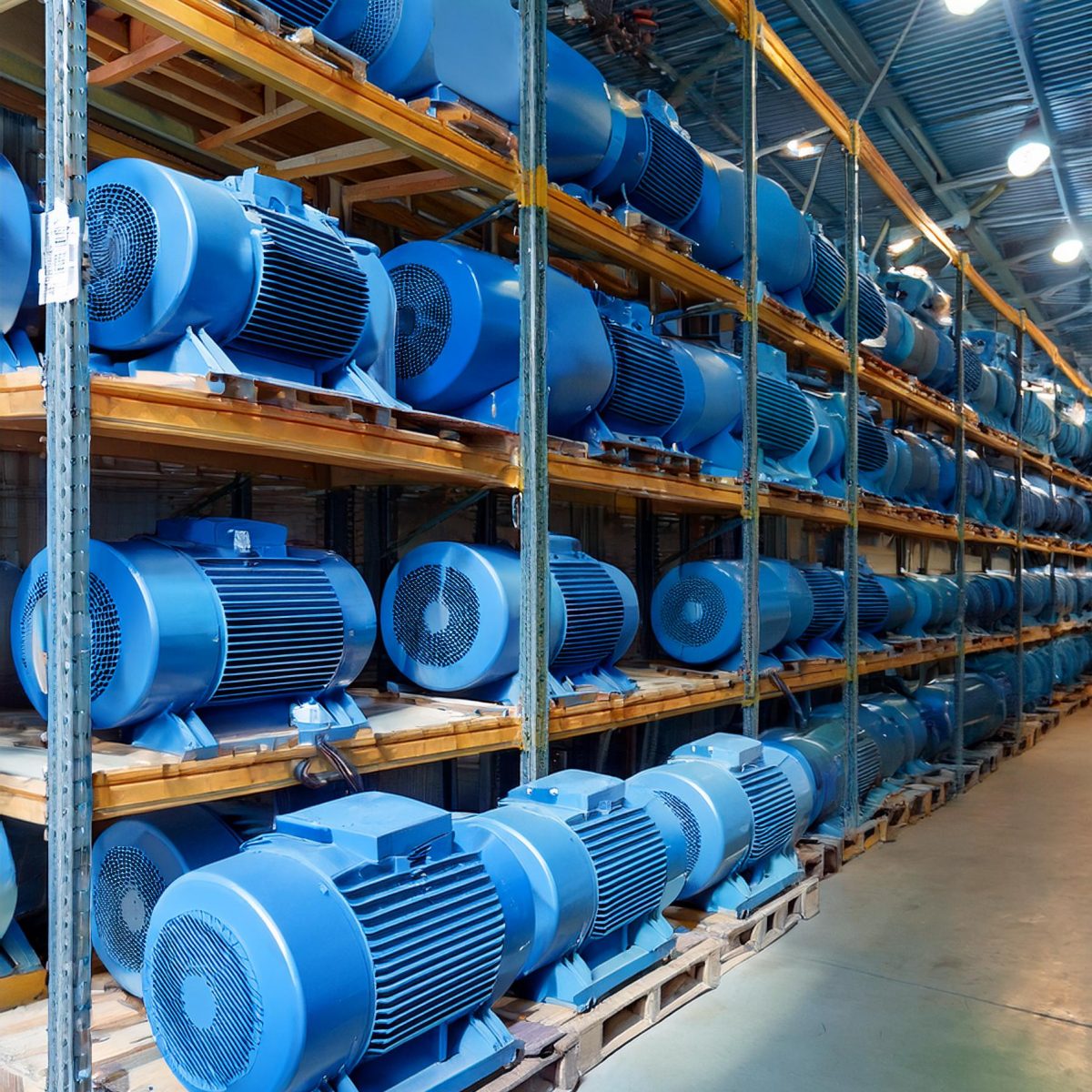
Electric motors are commonplace across the broad spectrum of industry, powering machinery and driving manufacturing processes, sitting at the very heart of production lines the world over. The diverse array of types, manufacturers, and models available on the market, paired with the recent improvements to technology in the fields of efficiency and monitoring, can make appropriate motor selection rather intimidating. At HAYLEY DEXIS, our specialist Drives team support our branches and their customers with the specification and supply of electric motors, gearboxes, geared motors, and inverters. We also hold authorised distributor status with industry-leading manufacturers, giving customers access to stock on expedited deliveries and unrivalled levels of technical support. In this article, we look at some of the key things to consider when purchasing electric motors, to ensure effective performance for the duration of the asset’s service life.
1. TECHNICAL PERFORMANCE REQUIREMENTS
The parameters the application requires the motor to perform within are essential to making the right choice when it comes to specifying any new motor. Units are graded on their power, torque, speed, and acceleration. These are fundamental characteristics to be aware of as matching the requirements of the application to the capabilities of the motor is vital to ensure your asset functions as expected. The duty cycle of a motor is an important factor too. Three broad classifications exist for this parameter: continuous running duty (S1), short-term duty (S2), and periodic duty (S3-S8). The different classifications reflect how long the motor operates for before reaching thermal equilibrium. S1 is defined as operation at a constant load, maintained for sufficient time to allow the machine to reach thermal equilibrium, S2 as short-time duty where rest breaks allow the machine temperature and coolant temperature to re-establish an equal footing, and S3- S8 where all periodic duty types are categorised. The first step in electric motor selection should always be calculating the torque (Nm) and speed (RPM) required. These figures are then used to calculate the desired power. Understanding duty cycles is also important, encapsulating operating times, starting, electric braking, no-load and rest periods. Acceleration is also a particularly useful characteristic to be aware of when a fast response time or quick start-up is needed.
2. ENVIRONMENTAL FACTORS
As with any mechanical component, the conditions in which an electric motor operates will affect its performance and service life. Ambient temperature needs to be considered. Does the temperature fluctuate wildly, or is the machine going to be operating in extreme heat conditions? At very low temperatures, specific bearings or a heating element will be required to protect the motor from seizing up. In aggressive environments, contamination will harm the health of the asset. Solid contaminants may come in the form of dust and debris in quarries and facilities handling products like cement. Liquid contamination could be because of water ingress from the high-pressure washdowns employed in food and beverage and pharmaceutical industries. Brushed motors and environments where aggressive, flammable gases are certainly not a good mix, with the brushes creating sparks and the gas providing a handy ignition source. There have been huge strides in recent years, creating innovative motors with effective seals, coatings, and casings, offering protection against these environmental factors. At HAYLEY DEXIS, we can advise on these if necessary for your application. Another question to ask is does the motor require approval for use within a certain environment? For example, ATEX-certified motors are required for certain hazardous zones and areas which expose machinery to flammable gases or combustible dusts.
"AT HAYLEY DEXIS, OUR SPECIALIST DRIVES TEAM ARE HERE TO ADVISE ON THE BEST ELECTRIC MOTOR FOR YOUR NEEDS."
3. INSTALLATION SETTING
It may seem obvious, but the dimensions and mounting style of an electric motor need to be appropriate for the footprint where it’s due to be installed. The available space needs to be considered, as well as the design of the drivetrain, when choosing an electric motor. With such a wide range of sizes available from small, compact units to larger, heavier models, it is easy to mistakenly buy a unit that just won’t fit. Attention must be paid to the mounting style too, with variations available such as outer flange-mounted (B5), foot-mounted (B3), and inner flange-mounted (B14). The design is defined by a code from the European IEC 34-7 Standard. Choosing the right mounting option helps to ensure that your motor is installed in a safe and secure manner. HAYLEY DEXIS hold authorised distributor status with many of the world-leading manufactureres, and the specialist technical staff within our Drives division assist branches and end-users everyday in selecting and optimising their electric motors and powertrains.
4. ENERGY EFFICIENCY
Approximately 70% of worldwide industrial electricity usage is used to power electric motor-driven systems. This highlights the importance of selecting efficient motors and optimising the design and operation of the system, including the use of variable speed drives. The transformation into manufacturing more energy efficient electric motors and other machinery and appliances has been steered by the super-efficient equipment and deployment (SEAD) initiative. This initiative has been successful in pushing manufacturers to rapidly accelerate the process of making their motors less power-hungry, in recent times. International Efficiency (IE) standards are assigned to all low voltage AC electric motors, with their level dependent on their minimum energy performance standards (MEPS). IE3 motors achieve around 96% efficiency on average, with IE4 suffering less energy loss than their IE3 counterparts, and IE5 motors delivering ‘ultra-premium’ levels of energy efficiency. IE6 ‘hyper efficiency’ motors became available in 2024.